by Joe Scarborough | May 5, 2026 | Morning Joe, News, Tea Spilled Morning Joe, The Tea Spilled Morning Joe, The Tea, Spilled
This is the May 5, 2026, edition of “The Tea, Spilled by Morning Joe” newsletter. Subscribe here to get it delivered straight to your inbox Monday through Friday.
JOE’S NOTE
A revolution in warfare is happening right now — and not in Iran.
The historic shift is occurring instead on the front lines of Ukraine’s war to push back its Russian invaders.
Fifteen months ago, President Donald Trump did his best to humiliate Volodymyr Zelenskyy inside the Oval Office, pressing the freedom fighter to make a bad deal with Trump‘s ally, Vladimir Putin.
“You have no cards left to play,” Trump bellowed to Ukraine’s president.
The American president promptly slashed U.S. military aid to the Ukrainians. His vice president — who yelled at Zelenskyy in the same White House meeting — later said his proudest achievement was abandoning the Ukrainians to Putin’s evil designs. And both Trump and JD Vance worked feverishly to pressure the Ukrainians to surrender land at the negotiating table the Russians could never win on the battlefield.
A year later, Ukraine is holding all the cards, striking down waves of Russian invaders with drone technology that is rewriting the rules of modern warfare.
Retired Gen. David Petraeus said recently, “The future of warfare is happening right now in Ukraine.”
As Russia’s economy teeters on the brink of collapse, it is now the former KGB agent who has holed himself up in secure bunkers — afraid of being assassinated by Russian oligarchs or Ukrainian drones.
Meanwhile, Zelenskyy strolls freely through the streets of European capitals once aligned with Russia — not as a refugee, but as a conquering hero.
European and Canadian leaders now line up to provide his warriors
by Brad Reed | May 5, 2026 | 22nd Amendment, Constitution, Donald Trump, judicial nominees, News, presidential term limits, Senate Judiciary Committee, third term
Political observers are expressing alarm after several of President Donald Trump’s lifetime judicial nominees refused to say whether he is eligible to run for a third term. During a Senate Judiciary Committee hearing on Thursday, Sen. Chris Coons (D-Del.) asked Trump judicial nominee John Marck to describe the 22nd Amendment of the US Constitution, which states that “no person shall be…
Source
by Steve Benen | May 5, 2026 | Maddowblog, News, Politics
Exactly two months ago, on the sixth day of the war in Iran, Donald Trump hosted a White House event intended to honor a championship soccer team, though the president took some time to comment on an issue on the minds of many.
“Yesterday, my administration announced decisive action to help keep down the oil prices,” the Republican declared. Moments later, he went on to say that oil prices “have pretty much stabilized.”
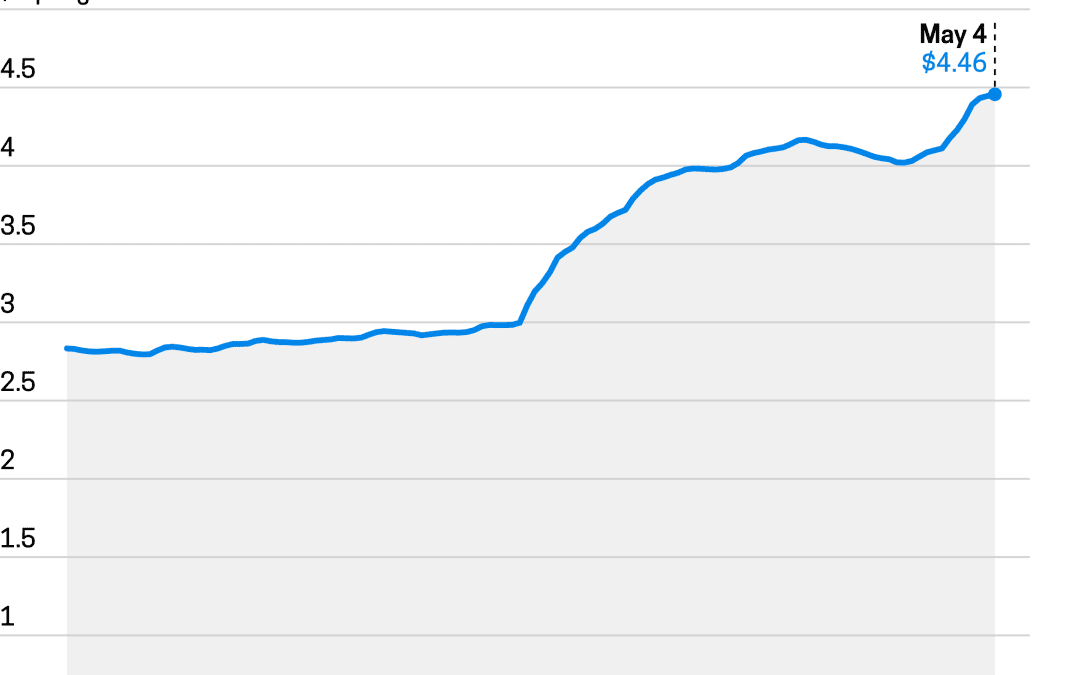
It was never altogether clear what “decisive” actions the president was referring to, but two months later, it’s painfully clear that those mysterious moves failed to “pretty much stabilize” prices. MS NOW reported:
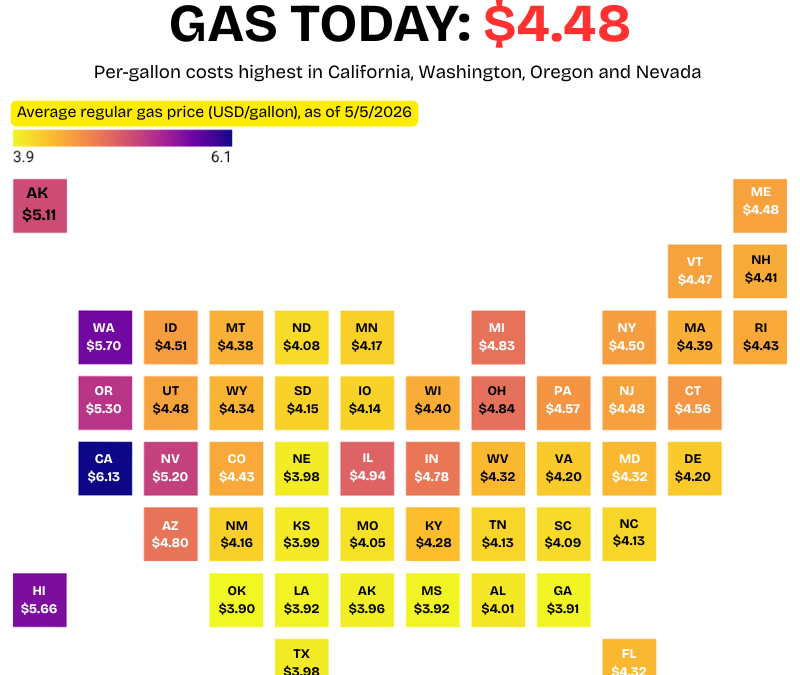
The average price for a gallon of gas in the U.S. reached $4.46 [on Monday] as the standstill in the Strait of Hormuz continues to strain global energy markets. The average price for one gallon of diesel fuel topped $5.64, according to national averages tracked by AAA.
A day later, that national average inched higher, reaching $4.48 per gallon, while the average for diesel climbed to $5.66.
Chart: Carson Elm-Picard / MS NOW; Source: AAA
An analysis published by Bloomberg News described the recent trend as the sharpest spike in pump prices in at least three decades, and while the president continues to insist that prices will plummet after the war, the fact remains that (a) it’s far from clear when the conflict will be over; and (b) dozens of energy sites throughout the Middle East have been struck as part of the war; wells have to be reopened; and some infrastructure will have to be rebuilt, all of which will take time.
As for the politics, the White House and
by Steve Benen | May 5, 2026 | Iran Tensions, Maddowblog, News, Politics
As the war in Iran got underway, Donald Trump’s strategy for the conflict was, among other things, shrouded in mysteries that shouldn’t have existed. Americans were left in the dark about why the United States went to war, whether the combat operations actually constituted a war, whether the war was legal, how much the war would cost, how long the war would last and whether the administration had a credible plan to achieve its vague objectives.
Two months later, the White House’s policy is still shrouded in mysteries that shouldn’t exist, but the list is evolving.
For example, as this week got underway, Iran reportedly mounted a missile-and-drone attack on commercial ships that U.S. forces were protecting in the Strait of Hormuz, while also targeting American warships. Soon after, the U.S. military said it sank six Iranian boats. Does that mean the ceasefire is over? As MS NOW reported in its live blog, the American president didn’t want to talk about it on Monday:
Trump declined to say whether the fragile ceasefire with Iran remains in effect, offering little clarity as tensions continue to escalate, in an interview with conservative radio host Hugh Hewitt.
Asked by Hewitt if the ceasefire was over, Trump replied, “Well, I can’t tell you that.”
So, on the one hand, we saw U.S. and Iranian forces trading shots, while Trump threatened anew to blow Iran “off the face of the Earth.” On the other hand, the American president who claims to have “terminated” combat operations would prefer not to tell the public whether the ceasefire remains intact or not.
There are secrets surrounding any war, but this need not be one
by Chris Walker | May 5, 2026 | 2026 midterms, Gerrymandering, News, partisan gerrymandering, Redistricting, Voting
A new analysis of midterm races for the House of Representatives set to take place this fall indicates that only 16 districts are considered true tossups, likely the fewest number of competitive seats seen in a midterm election since such observations began in the 1980s. The Cook Political Report, which analyzes all 435 House races (as well as Senate races and presidential elections)…
Source
by Steve Benen | May 5, 2026 | Maddowblog, News, Politics
During Defense Secretary Pete Hegseth’s appearances on Capitol Hill last week, he repeatedly leaned on a lazy rhetorical strategy. Confronted with tough questions, the beleaguered Pentagon chief tried to defend himself by changing the subject to the recent past.
When Hegseth was pressed, for example, to defend his record of mass firings at the Defense Department, he had an answer he appeared to have prepared in advance. “Under Barack Obama, 197 general officers were removed,” he said in sworn testimony. “So this is not something specific to this administration.”
The problem, however, is that the secretary’s defense wasn’t true, and as The New York Times reported, “The number Mr. Hegseth gave has no basis in fact.”
Making matters worse, this was not the only instance in which the former Fox News host relied on false claims about recent Democratic administrations.
The defense secretary was also asked whether he would be willing to deploy U.S. troops to local voting precincts ahead of this year’s midterm elections. Instead of answering the question directly, Hegseth again looked backward, in keeping with his borderline-creepy fixation on Joe Biden.
“I will note that in 2024, troops were — that was Joe Biden, by the way, Joe Biden — were deployed to polling locations in 15 states,” Hegseth said in sworn testimony to the House Armed Services Committee. For good measure, he repeated, “2024 — Joe Biden — troops deployed to polling locations in 15 states. Explain that one to me.”
A day later, the secretary made the same claim in nearly identical wording during sworn testimony to the Senate Armed Services Committee.
Readers can probably guess where this is headed. CNN reported:
All