by Steve Benen | May 28, 2026 | Maddowblog, News, Politics
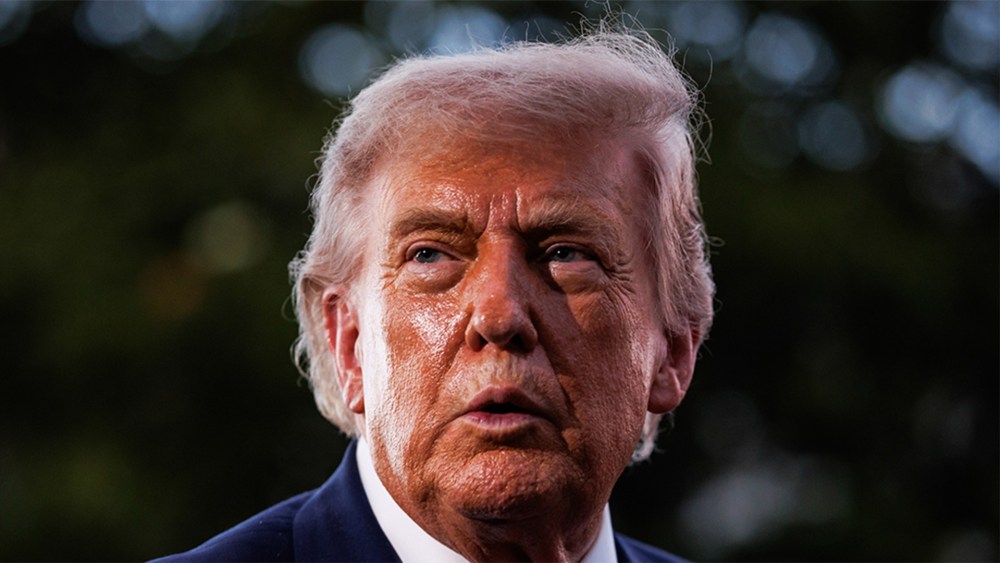
Under existing law, American consumers pay a gas tax of 18.4 cents per gallon (24.4 cents for diesel and 19.3 cents for jet fuel), which generates revenue that is used for road maintenance through the Highway Trust Fund. Earlier this month, however, as the war with Iran pushed prices at the pump higher, Donald Trump announced plans to suspend the tax as a way to reduce costs.
There was some pushback, not just because of the nation’s infrastructure needs, but also because the savings would be minimal. As MS NOW’s Hayes Brown explained two weeks ago, “If put into place today, one economist suggested that a gas tax holiday would only save drivers roughly 60 cents total per trip to the pump, a drop in the tank compared to the $1.50 per gallon leap we’ve seen since Trump launched the Iran war more than two months ago.”
The president didn’t care. The pause, the Republican told CBS News, was “a great idea.” He also made it sound as if the change was definitely going to happen, adding, “We’re going to take off the gas tax for a period of time.”
So what happened? Toward the end of the latest White House Cabinet meeting, a reporter asked Trump about his expectations for the federal gas tax.
“A gas tax holiday?” he replied. “Well, it’s something we might talk about. Let’s see what happens over the next week or two weeks.”
As always, the president’s “two weeks” reference effectively gave away the game: Every time he uses the phrase (which is painfully often), he’s trying to avoid giving a straight answer to a question he doesn’t know
by Julia Conley | May 28, 2026 | Department of Justice, doj, Donald Trump, E. Jean Carroll, News, Sexual Assault
President Donald Trump appeared to be out for what one human rights advocate called “outrageous revenge” late Wednesday as it was reported that the Department of Justice has opened a criminal investigation into former magazine columnist E. Jean Carroll, who won two civil judgments against the president after accusing him of sexual abuse and defamation. CNN first reported that…
Source
by Allison Detzel | May 28, 2026 | News
As tensions between the United States and Cuba continue to rise, Cuba’s foreign minister, Bruno Rodriguez Parrilla, tells MS NOW that a war between the two countries would provoke a “humanitarian catastrophe” that could lead to the deaths of thousands.
“If Cuba were attacked, it would have to defend itself,” Rodriguez told Antonia Hylton on Wednesday. “It would lead to bloodbath — the death of thousands of Cubans, and also the deaths of young Americans.”
During a sit-down interview with Hylton, conducted in Spanish and translated into English by MS NOW, Rodriguez said the Trump administration’s decision in January to effectively cut off the country’s fuel supply has had “increasingly severe consequences” for the Cuban people, causing blackouts and shortages of food and medical supplies.
“The Cuban people are suffering a kind of collective punishment,” he said. “They are subjected to conditions that violate their human rights and cause pain, suffering, and anguish to Cuban families.”
“The worst part is that these consequences are not some kind of collateral damage, as the U.S. government often claims, but rather the result of a deliberate design to provoke suffering among the Cuban population,” Rodriguez added.
The situation between the two longtime adversaries escalated earlier this month when the U.S. announced that a grand jury had indicted 94-year-old former Cuban President Raúl Castro on murder charges related to the 1996 downing of two small planes.
Rodriguez called the charges “politically motivated and illegal,” adding it was “extraordinary that this is happening 30 years after those events,” which he described as “an act of legitimate self-defense by the Cuban state after 25 violations of its airspace.”
“They are doing this to
by Steve Benen | May 28, 2026 | Maddowblog, News, Politics
Partway through Donald Trump’s latest White House Cabinet meeting, a reporter asked the president a relatively straightforward question related to the Strait of Hormuz and its future: “Would you accept a short-term deal that allows Iran and Oman to control the strait, and would they have to open immediately, or would you be open to that happening over a period of time?”
Trump responded that the waterway will “be open to everybody.” Pressed further on which country would control the Strait, the Republican added, “It’s international waters. Nobody’s going to control it. We’re going to watch over it. We’ll watch over it but nobody’s going to control it.”
If he’d stopped the answer there, the exchange would have been largely unremarkable. The president, however, decided to add one additional thought.
Trump: “Oman will behave just like everyone else, or we’ll have to blow them up”— Aaron Rupar (@atrupar.com) 2026-05-27T17:00:28.657Z
“Oman will behave just like everyone else, or we’ll have to blow them up,” Trump warned. Referring to officials in Oman, he added, “They understand that.”
In other words, according to the American president, he’s prepared to start bombing a longtime U.S. ally if it partners with Iran to share control of the Strait of Hormuz.
As part of the network’s on-air coverage of the Cabinet meeting, Fox News’ John Roberts noted Trump’s threat and told viewers, “Not quite sure what that was all about.”
Oddly enough, I had the same reaction.
A Politico report noted that Oman “has been a key interlocutor in behind-the-scenes negotiations with Iran over its nuclear program and more recently in the push to end the war between Tehran and Washington.” Those diplomatic efforts

by Mychael Schnell | May 28, 2026 | News
President Donald Trump and Senate Republicans are headed for a showdown over the administration’s $1.776 billion “anti-weaponization fund” — with no clear resolution in sight.
When the Senate skipped town last week and punted on an immigration enforcement reconciliation bill, a major reason for the delay was the deep GOP discontent with the fund and concerns that Republicans would support Democratic amendments to block the proposal.
Now, as senators prepare to return next week, it’s unclear how Trump or Senate Republican leaders plan to navigate the reconciliation bill and a slate of amendments that could be adopted to effectively neuter the fund.
Play
‘Obviously illegal’: Ex-Trump staffer shreds Trump’s $1.8 billion fund, says it’ll be ‘decimated’ in court
May 26, 2026 / 11:15
Senate Republicans seem to think it’s on Trump to find the votes for the fund if he wants the money.
“They were the ones who created this,” a senior Senate GOP aide told MS NOW on Wednesday. “It is very clearly a problem with our members. And our members believe it is theirs to fix.”
The senior staffer, who requested anonymity to discuss the internal dynamics, said GOP senators are “still waiting to see what, if anything, the administration comes back with.”
In the meantime, Senate Republicans have raised a range of options on how to proceed, the aide said, including eliminating the program altogether, giving Congress more of a say over who’s appointed to the commission overseeing the fund, getting the judicial branch involved in the process, and creating concrete standards for eligibility to benefit from the fund.
The last point has been particularly pressing for lawmakers, as many raise concerns about individuals who violently stormed
by The Associated Press | May 28, 2026 | News
BANGKOK (AP) — The International Stabilization Force for Gaza was announced with great aplomb at the inaugural meeting of U.S. President Donald Trump’s Board of Peace in February. The American general tapped to lead the 20,000-strong force said it would ensure “future prosperity and enduring peace” after the devastating Israel-Hamas war.
Three months on, he still has no force to lead as none of the five countries that pledged troops have come through with any significant contributions.
Efforts to shore up the fragile ceasefire have stalled as Hamas has refused to disarm and Israel has seized more territory while continuing to strike what it says are militant targets, often killing civilians.
The Iran war has meanwhile made it more difficult for Arab and Muslim leaders to openly cooperate with the United States and Israel, which many in the region view as aggressors, and the resulting global energy crisis has sapped their resources.
Indonesian commitment of 8,000 troops on indefinite hold
The biggest blow to the planned force came about a week after the U.S. and Israel attacked Iran on Feb. 28, when Indonesia put its commitment of 8,000 troops on indefinite hold. Some 1,000 were to have been sent in April, followed by the remainder in June.
Indonesian’s pledge was by far the largest of the group, which also includes Morocco, Kazakhstan, Kosovo and Albania. U.S. Maj. Gen. Jasper Jeffers, who spoke at the Board of Peace event, was to command the force.
Indonesia suspended its plans over what Defense Minister Sjafrie Sjamsoeddin said last week seemed to be a lack of commitment from a distracted Washington, saying “we have not yet received any implementation guidelines.”
“New dynamics have emerged,” he told parliament. “Because the intensity of the conflict between U.S.