by Clarissa-Jan Lim | Jun 20, 2026 | News
Iran’s military declared Saturday that the Strait of Hormuz is closed due to Israeli attacks on Hezbollah in Lebanon, The Associated Press reported citing Iranian state media, on the eve of detailed talks about a long-term peace deal.
U.S. Central Command countered shortly afterward that commercial ship traffic in the strait actually increased Saturday “as U.S. forces continued operating in the general area to support freedom of navigation.”
Iran blamed Israel for violating a freshly announced ceasefire with Hezbollah by continuing to attack targets in Lebanon. The Israeli military, in turn, accused the Tehran-backed militia of breaking the terms first.
The conflicting statements about the crucial maritime chokepoint and the state of play in Lebanon come as U.S. and Iran officials head to Switzerland to dig into specifics after landing a much-trumpeted but general memorandum of understanding earlier this week.
Access to the Strait of Hormuz has been a major point of leverage for Iran in the war. Iran agreed to reopen the strait to commercial vessels as part of the memorandum of understanding with the U.S., and its closure is a development that U.S. officials had feared amid ongoing talks.
Vice President JD Vance said on Fox News early Saturday that there was no evidence that the strait remains closed, though he acknowledged that mines in the waterway may continue to affect commercial routes. It’s unclear if Vance was aware of the latest reporting on the strait during his interview.
Vance said special envoy Steve Witkoff and President Donald Trump’s son-in-law, Jared Kushner, have been on the ground in Switzerland “for a few hours dealing with some of the technical elements” regarding talks on implementation
by Mike Ludwig | Jun 20, 2026 | Donald Trump, Inflation, Iran, iran war, Military Spending, News, War, weapons
The day before he signed a memorandum of understanding with Iranian leaders, President Donald Trump said he wants to put the joint U.S.-Israeli war on Iran in the “rearview mirror.” But even if the memorandum — which puts an end to the war for at least the next 60 days — holds, the enormous costs of the war itself will not disappear with the next news cycle. In Iran, at least 3,468…
Source

by Allison Detzel | Jun 20, 2026 | News
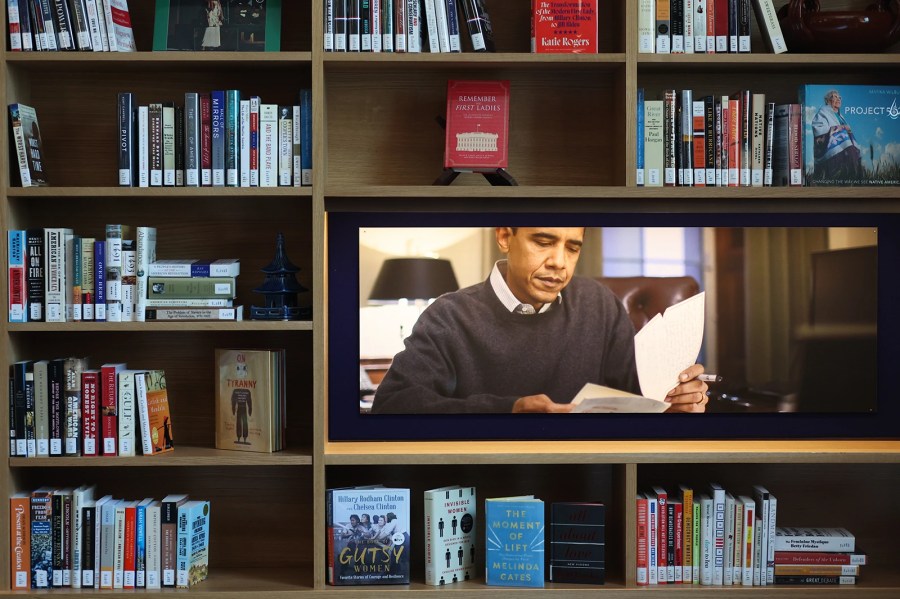
After more than a decade in the making, the Obama Presidential Center has opened its doors. To mark the occasion, former President Barack Obama and former first lady Michelle Obama sat down with MS NOW’s Michele Norris to talk about the stories that helped inspire the center, their legacy and how they believe “America will see itself” reflected throughout the sprawling 19-acre campus in Chicago’s South Side.
While the former president told Norris the construction of the center was a “long journey,” he said that throughout the process, he and the former first lady had a consistent vision of what they hoped to “accomplish,” one that started with its location, which he described as the “epicenter” of his life in Chicago: the South Side.
“Michelle and I had a very clear sense that we wanted this to be a place that would attract visitors from around the world, that would record what happened during my presidency, but, that more than anything, was a vital, alive, dynamic place for the South Side of Chicago and the city of Chicago,” he said.
“We are home,” Michelle Obama told Norris, speaking from inside the center’s reading room. The former first lady, who was born and raised in Chicago’s South Side, said that during her childhood, she could not imagine having access to anything like the presidential center, which includes 28 commissioned art installations scattered throughout the campus.
“In order to do or see or experience anything beyond what you knew, you had to get on a bus or pay for parking or take the L and go to a whole other community to experience beautiful parks and
by Julia Jester | Jun 19, 2026 | News
As talks loom between the U.S. and Iran, negotiators face a simple and daunting task: turning a 14-point memorandum of understanding into a comprehensive nuclear deal within 60 days.
The ticking clock was set in motion on Thursday, according to Vice President JD Vance, following the signing of the MOU one day earlier. That signing brought an official end to military hostilities. What it did not do is resolve the conflict that caused them.
Some agreements took effect immediately upon signing: a cessation of hostilities, the reopening of the Strait of Hormuz, the lifting of the U.S. naval blockade, the issuing of oil waivers and initial steps to unfreeze billions of dollars in Iranian assets.
But those were the easy parts.
What remains are the metaphorical landmines — the unresolved questions the MOU largely deferred rather than decided, each with the potential to blow up any prospect for a nuclear deal. On Thursday evening, the White House announced that Vice President JD Vance will not attend talks in Switzerland that had been planned for Friday — a decision that may well be read as a signal of just how far apart the two sides are. A White House spokesperson acknowledged in a statement that while the U.S. delegation has been prepared to depart at the first available opportunity, “the logistics of these negotiations have never been simple or predictable.”
Here is what the negotiators will actually have to solve:
The future of the Strait of Hormuz
The MOU ensures safe passage of commercial vessels through the Strait of Hormuz “with no charge for 60 days only,” and outsources the negotiating responsibility for ensuring long-term toll-free
by Kevin Frey | Jun 19, 2026 | News
As President Donald Trump and Iran move forward with a memorandum of understanding to end the war, many congressional Republicans are expressing unease about what the emerging deal means for the United States.
But several Republicans have also expressed concern with what the agreement means for another country: Israel.
Several Republicans told MS NOW they are particularly distraught with a provision calling for an “immediate and permanent termination of military operations on all fronts, including in Lebanon” — language they fear could constrain Israel’s campaign against Hezbollah.
Play
‘We’ve made the world more dangerous’: Former top CIA official reveals global havoc caused by Trump
June 18, 2026 / 08:11
In recent weeks, Israel has continued strikes on southern Lebanon, targeting Hezbollah there. Israel even struck Lebanon after the memorandum was announced.
When MS NOW asked Republicans on Thursday if the Iran deal was good for Israel, GOP lawmakers expressed a number of worries.
Sen. Mike Rounds, R-S.D., took issue with the fact that Israel seemed to have been cut out of the negotiations, saying he’d like to find out what the Trump administration’s “thought process” was on that.
Sen. John Cornyn, R-Texas, similarly took issue with Israel getting cut out — going so far as to suggest that Israel should perhaps ignore the deal.
“They’ve got their own interests at stake, and you know, I would encourage them to continue to take the fight to Hezbollah,” he told MS NOW.
Like many other Republicans, Cornyn also took issue with the memorandum’s provision calling for up to $300 billion in reconstruction money for Iran.
“Unfortunately, now Iran is going to have hundreds of millions of dollars to support its terrorist proxies, including Hezbollah,”
by Fallon Gallagher | Jun 19, 2026 | News
The Trump administration refused to formally kill its nearly $1.8 billion “anti-weaponization” fund on Friday, declining to submit a court-requested sworn declaration to a federal judge acknowledging the program is dead.
Instead, the Department of Justice continued to rely on Acting Attorney General Todd Blanche’s congressional testimony that the administration is not moving forward with the fund.
In a notice to the court, the DOJ wrote, “Such declarations are unnecessary and the compelled testimony of senior officials from the Executive Branch implicates serious separation of powers concerns.”
The refusal by Blanche and the DOJ to put a pledge in writing not to create the fund — aimed at compensating those who believe they were the victims of alleged prosecutorial overreach —is likely to spark political backlash, especially on Capitol Hill where Blanche’s permanent nomination to head the department is pending.
The DOJ maintains its public statements — both in Blanche’s congressional testimony and in written court filings and hearings — should be sufficient. “All these statements were made under the backdrop of serious penalties for falsity,” it writes. “So there is no reason why declarations should affect the Court’s mootness analysis.”
The refusal by Blanche and the DOJ to put a pledge in writing not to create the fund — aimed at compensating those who believe they were the victims of alleged prosecutorial overreach — is likely to spark political backlash.
However, the department’s statements about serious penalties regarding Blanche’s testimony are somewhat misleading. One potential penalty is a criminal statute that punishes false statements made to Congress. That statute can only be enforced by the DOJ itself.
The other penalties the DOJ mentions in the