by David Rohde | Jul 13, 2026 | News
A new White House task force reviewing thousands of pages of classified intelligence and law enforcement documents for evidence of irregularities in U.S. elections is expected to begin releasing documents within weeks, two U.S. officials with knowledge of the matter told MS NOW.
The Office of the Director of National Intelligence, whose acting chief, Bill Pulte, has been accused by Democrats of politically weaponizing federal government information, will be part of the effort. Democrats say that Trump has placed Pulte in the position so that he can aid Republicans in the midterm elections and potentially limit voting by Democrats.
Pulte has no intelligence experience and also serves as the administration’s top federal housing official. Pulte referred multiple Trump political rivals for Justice Department criminal prosecution last year based on mortgage information he obtained from government databases. None of those cases have resulted in convictions.
The release of the documents appears to be part of a series of accelerating efforts by Trump and his aides to again question the results of the 2020 election, claim that widespread voter fraud occurs in the country and decrease public trust in the results of pivotal elections this fall that will decide control of Congress.
Play
‘Actions of a traitor’: Trump escalates assault on voting rights as midterms near
July 2, 2026 / 09:45
“I don’t think we’ve ever seen an administration that is this hostile to voting rights and free and fair elections,” said Jonathan Diaz, the director of voting advocacy at the Campaign Legal Center, an ethics watchdog group. “This is a new frontier.”
Election security experts and election officials have long expected the Trump administration to release more government documents
by Erum Salam | Jul 12, 2026 | News
Democratic Senate nominee James Talarico appears to have an advantage over his GOP rival among Hispanics in the business sector in Texas, a sign the historically red seat could flip blue.
A U.S. Hispanic Business Council survey, first shared with Politico, found that Talarico leads state Attorney General Ken Paxton by a 7-point margin, 43% to 36%, among Texas Hispanic business owners.
Two reasons are the Trump administration’s increasingly unpopular deportation practices and the rising cost of living.
“The fear factor that it creates, the disruption that it creates, the environment that it creates, is debilitating,” Javier Palomarez, president and CEO of United States Hispanic Business Council told Politico. “If you’ve got a small business of 10 people or so, and you get even one person deported, you can imagine what that does to the morale of that business unit and to the fear of the business owner.”
The survey shows that seven in ten Hispanic business owners said their businesses had been impacted by Trump’s tariffs. One in five said they’ve had an employee deported in the past year amid Trump’s immigration crackdown.
Hispanic-owned businesses that have lost workers because of deportations are concentrated in food services, tourism and hospitality, construction, automotive and manufacturing.
The survey found that cost of living is a unifying issue, with 61% of Republicans, 60% of Democrats and 60% of Independents listing it as one of their top three issues.
Almost one quarter of those surveyed who supported Sen. John Cornyn over Paxton in the Texas GOP primary for Senate now say they’ll back Talarico. Still, over half say they’ll back Paxton.
Talarico and Paxton did not immediately respond to MS NOW’s request for comment on the
by Mychael Schnell | Jul 12, 2026 | News
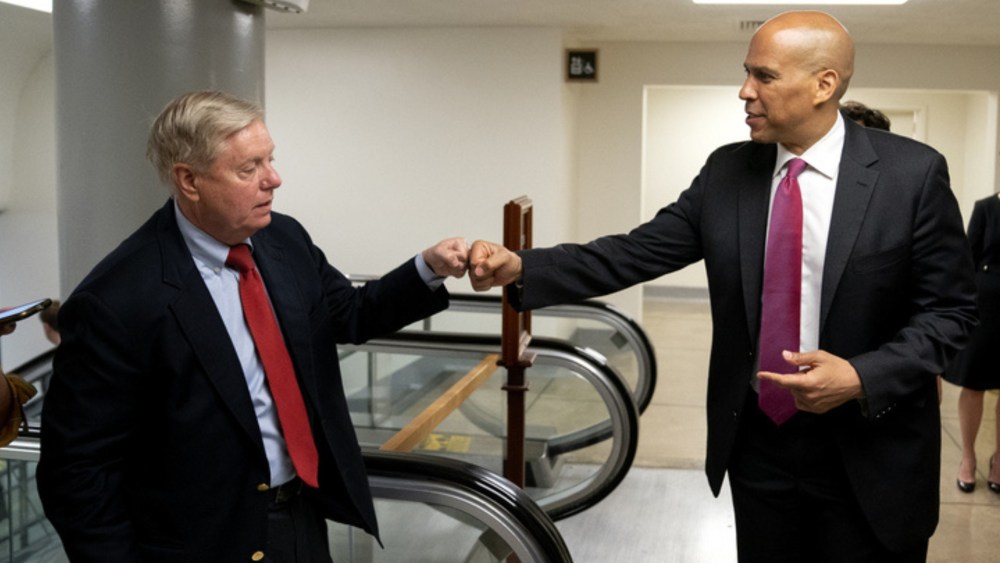
The sudden passing of Sen. Lindsey Graham, R-S.C., could put Republicans in a bind ahead of key votes less than four months from the midterms, including those to advance White House initiatives and nominees.
The issues are not insignificant. They include President Donald Trump’s request for a massive defense spending package amid the Iran war, funding for the State Department and a looming confirmation battle over whether to advance the president’s nomination of Todd Blanche to become permanent attorney general.
Just on Friday, Graham, who was a staunch supporter of Ukraine, announced that he and a bipartisan group of senators won White House support for a bill sanctioning Russia.
Graham, whose office said he died Saturday night “from from a brief and sudden illness,” was a member of the Senate Judiciary Committee, Appropriations Committee and Budget Committee, which he chaired.
South Carolina Gov. Henry McMaster is tasked with appointing Graham’s temporary replacement until a special election takes place later this summer to choose his successor. In response to an email from MS NOW requesting information about the Senate and ballot vacancy, a spokeswoman for the governor said, “At this time, our focus is on honoring Senator Graham’s life and service. Questions regarding the process for filling the vacancy will be addressed by the Governor’s Office when there are updates to share.”
Play
We fought ‘like Hell’ but ‘forged a friendship’: Sen. Booker on Sen. Graham
July 12, 2026 / 08:27
There is at least some precedent for what happens next. After Sen. Dianne Feinstein, D-Calif., died in September 2023, Laphonza Butler, D-Calif., was named her replacement by California Gov. Gavin Newsom. Then, after she was approved by unanimous
by Communications Staff | Jul 12, 2026 | News
The National Endowment for Democracy (NED) mourns the passing of Senator Lindsey Graham, a devoted public servant and one of Congress’ most steadfast champions for freedom and democracy around the world. Throughout his distinguished career in public service, Senator Graham defended those resisting tyranny and advanced democratic principles while standing firm with those who refused to surrender…
Source
by The Associated Press | Jul 12, 2026 | News
DUBAI, United Arab Emirates (AP) — The United States attacked Iran early Sunday morning over an Iranian strike on a vessel in the Strait of Hormuz that set the container ship ablaze and forced its crew to abandon it. Iran responded with attacks targeting several countries in the Middle East, including Bahrain, Kuwait, Qatar, Oman and Jordan.
The burst of fighting raised new questions about efforts to reach a permanent end to a war that began on Feb. 28. The strait, a key transit route for oil and natural gas, has become the key sticking point in negotiations, and repeated fighting over the past week has left negotiations in danger of collapse.
The U.S. military’s Central Command said it hit some 140 targets in Sunday’s strikes and went after missile and drone launch sites, ammunition dumps, communication equipment and other sites. It said the attacks, heavier than previous attacks in recent days, would weaken Iran’s ability to threaten civilian shipping.
“Iran made a poor choice. Now they pay,” U.S. Defense Secretary Pete Hegseth wrote online.
Semiofficial Iranian news agencies reported that a navy officer was killed by the early morning attack. Iran retaliated by attacking nations in the region hosting U.S. military forces, while insisting it alone must control the strait and potentially charge vessels for traveling through it.
“The era of one-sided deals is OVER,” Mohammad Bagher Qalibaf, the speaker of Iran’s parliament and a main negotiator, wrote Sunday. “We told you: keep your word or pay the price. Reality is knocking.”
Iran and the U.S. agreed to an interim ceasefire on June 17, beginning a 60-day period aimed at reaching a permanent end to the
by Emma Freer | Jul 12, 2026 | News
When Congress passed a spending package earlier this year, few industries were more disappointed than pharmacy benefit managers. PBMs are middlemen who liaise between insurers, drug manufacturers and pharmacies to determine which drugs are covered at what price. Their job, as the New York Times reported in 2024, “is to reduce drug costs. Instead, they frequently do the opposite. They steer patients toward pricier drugs, charge steep markups on what would otherwise be inexpensive medicines and extract billions of dollars in hidden fees.”
The spending bill’s provisions limited some common PBM practices, and the industry declared itself sufficiently regulated. But policymakers are rightly refusing to move on. They are now proposing even more aggressive legislation that would extend not just to PBMs but to other “Big Medicine” middlemen — such as insurance conglomerates and wholesale drug distributors — that drive healthcare costs up and independent providers out of business.
Americans receive middling healthcare yet face the highest medical costs in the world. Meanwhile, six of the country’s 15 most valuable companies are Big Medicine conglomerates, more than from any other sector, including Big Tech. Together, these six generated nearly $34 billion in profits last year alone, according to annual reports.
Big Pharma abuses patents to keep drug costs high and block competition from more affordable generics. But that doesn’t let Big Medicine off the hook.
PBMs demonstrate, in microcosm, the Big Medicine problem. The “big three” PBMs — CVS Caremark, Cigna’s Express Scripts and UnitedHealth Group’s Optum Rx — not only control 80% of U.S. prescriptions but also are each vertically integrated with a major insurance conglomerate and a major pharmacy. There is overwhelming evidence that these