by Shahad Ali | Jun 3, 2026 | Gaza, Israel, News Analysis, Palestine, Yellow Line
As part of the first phase of the U.S.-brokered ceasefire in Gaza in October last year, the Israeli army withdrew to what it called the “Yellow Line” — a temporary demarcation line inside the Gaza Strip that separated areas under Israeli military control from areas where people in Gaza are allowed to live and move. At the time, the Israeli military controlled 53 percent of the Gaza Strip.
Source
by Shireen Akram-Boshar | May 29, 2026 | Board of Peace, Donald Trump, Gaza, Israel, News, Palestinian Authority, United Nations
President Donald Trump’s “Board of Peace” fund has no money for the reconstruction of Gaza, despite raising billions of dollars since January. On Wednesday, the Financial Times reported that “Zero dollars have been deposited” into the board’s financial fund — but that the body has received donations directly into its JP Morgan bank account, which allows it to override transparency…
Source
by Shireen Akram-Boshar | May 29, 2026 | Benjamin Natanyahu, Donald Trump, Gaza, Gaza Ceasefire, Netanyahu government, News
Israeli Prime Minister Benjamin Netanyahu said on Thursday that he had directed the Israeli military to take over 70 percent of the Gaza strip. In comments at a conference hosted by a “pre-military” academy in an illegal settlement in the occupied West Bank, Netanyahu said that his “directive is to move to… take [Gaza] step by step… first of all 70 percent.” “One hundred! One hundred!”…
Source

by Tareq S. Hajjaj | May 29, 2026 | Article, Gaza, Israel, Palestine, Politics and Movements: International, Reprint
This story originally appeared in Mondoweiss on May 29, 2026. It is shared here with permission.
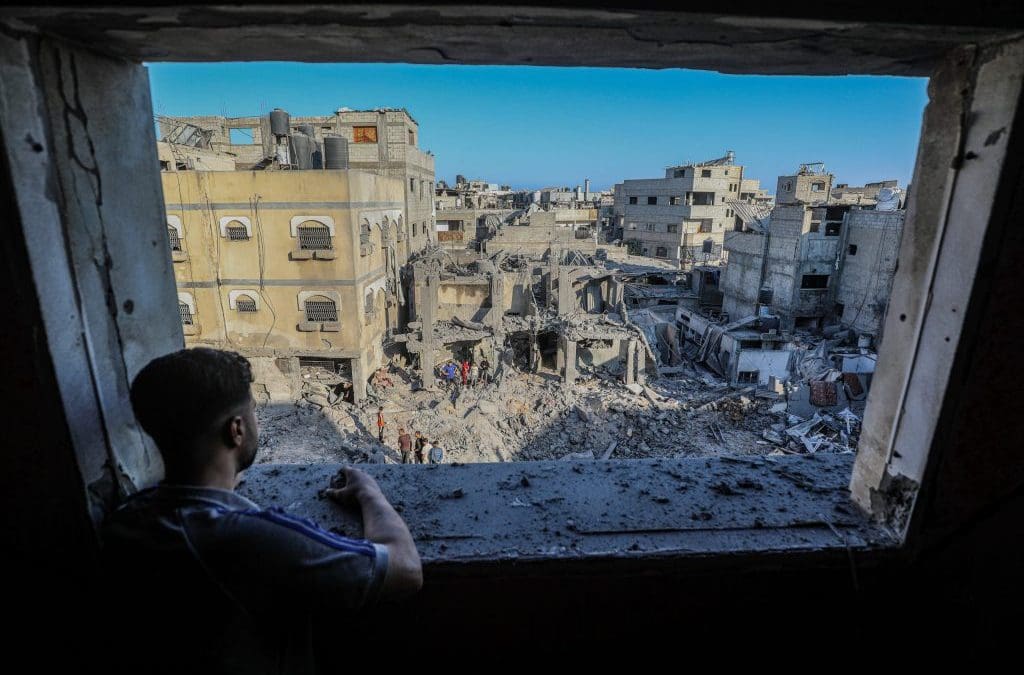
On May 24, Karam Ismael, 43, received a phone call from someone who identified himself as an Israeli army officer. The caller delivered one message: evacuate your home in 20 minutes before we bomb it. At first, he thought it was another scare tactic, similar to the messages the Israeli army used to send during incursions into neighborhoods. It was one of several calls made to residents of Nuseirat refugee camp in central Gaza, with a warning that covered residential blocks near al-Quds Supermarket and a local UNRWA clinic. The area included dozens of homes that had not previously been bombed throughout the past two years.
Four minutes after receiving his first call, Ismael’s phone rang again. The officer told him they had 10 minutes left, ordering him to evacuate immediately and to notify his neighbors. This time, he took the threat seriously and fled with his neighbors, leaving his belongings behind.
After half an hour, quadcopter drones appeared and hovered above the residential block, followed by the fighter jets. The entire block was leveled.
This was not the first such incident in recent weeks in which the Israeli army warned entire residential areas to evacuate and then bombed their homes. The Israeli army has been following a new pattern during the ceasefire: targeting residential blocks that had not experienced a ground invasion and had not been bombed during the war, remaining intact and still sheltering their owners. Over the past week, the army appears to have escalated this approach by specifically targeting residential blocks that had previously remained
by Shireen Akram-Boshar | May 28, 2026 | Anthony Blinken, Biden Administration, Democratic Party, Gaza, Gaza Genocide, Genocide, Israel, News, Sen. Chris Van Hollen, US military aid to Israel
In an op-ed in the The New York Times on Tuesday, Sen. Chris Van Hollen (D-Maryland) condemned members of his own party for their approach to the “Israeli-Palestinian conflict,” saying that “Democrats failed to meet the moment in 2024.” The op-ed comes as Biden administration advisors who helped engineer Israel’s genocide in Gaza are regrouping in an effort to shape the party’s approach to…
Source
by Shahad Ali | May 27, 2026 | Eid, Gaza, Gaza Blockade, Genocide, Hajj, Islam, Israel, Op-Ed
Eid al-Adha in Gaza had always been known as the “Big Eid,” given that its celebrations were more extensive than those of Eid al-Fitr. Eid al-Adha, or the “Feast of Sacrifice,” which commemorates Ibrahim’s willingness to sacrifice his son as an act of submission to God, is the most important Islamic holiday and begins during the Hajj on the 10th day of the Islamic lunar month of Dhul-Hijjah.
Source