by Chris Walker | Nov 5, 2026 | 2026 Elections, Congress, Donald Trump, Hakeem Jeffries, House of Representatives, Impeachment, News
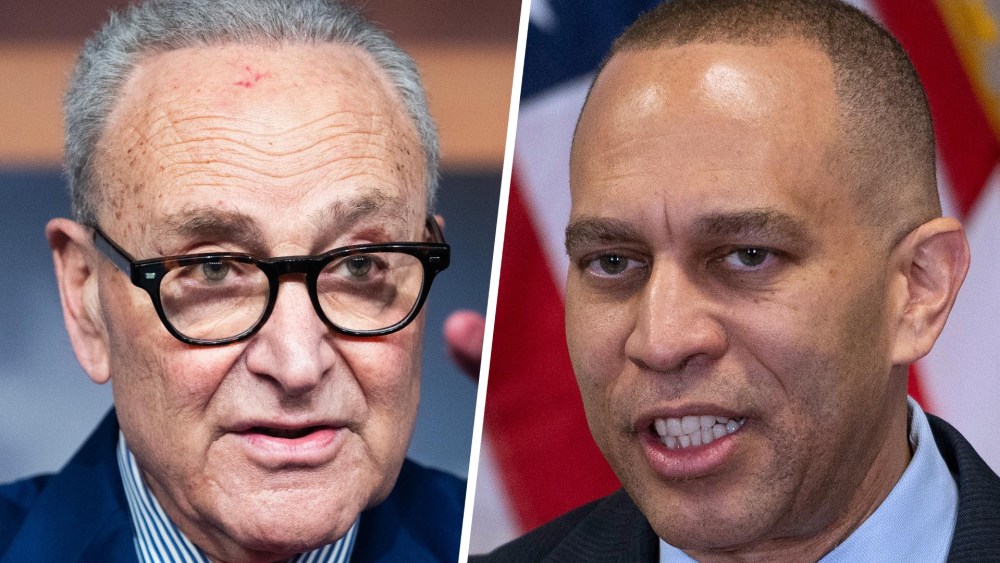
House minority leader Rep. Hakeem Jeffries (D-New York) is downplaying the potential to hold the Trump administration accountable following Democrats’ monumental win in the 2026 midterm elections, despite a large proportion of voters signaling that they believe there are grounds for impeaching President Donald Trump. In an interview following the midterm elections, Jeffries…
Source
by Ja'han Jones | Nov 4, 2026 | Congress, elections, Opinion
Democrats’ wave of victories in the midterms has drowned the House Freedom Caucus.
The dubiously named caucus of GOP lawmakers — a cadre known to include traffickers in white supremacy, antisemitism and Islamophobia — had been on wobbly footing in recent years amid some prominent departures and growing evidence of its political impotence.
Now the next Congress will convene with several of the staunchest caucus members missing.
Arizona Rep. Andy Biggs declined to run for re-election so he could launch a gubernatorial bid, which failed. Same with Wisconsin Rep. Tom Tiffany.
South Carolina Rep. Ralph Norman, who led failed bids for governor and the U.S. Senate this year, won’t be returning to Capitol Hill either. Pennsylvania Rep. Scott Perry lost his seat to a Democratic opponent on Tuesday. And Reps. Lauren Boebert of Colorado and Eli Crane of Arizona seem to be at risk of losing their seats as well.
Even if Boebert and Crane eventually win, they’ll have both received resounding messages from thousands of voters who clearly don’t have an appetite for extremists.
The best story Republicans can take from the dwindling House Freedom Caucus is that of Florida Rep. Byron Donalds, who won’t be returning because he was elected governor.
So continues the caucus’s ongoing evaporation. Once a hotbed for conservative firebrands, it’s being extinguished with the help of Tuesday’s “blue tsunami.”
The post This electoral blue wave has drowned the House Freedom Caucus appeared first on MS NOW.
by Steve Benen | Nov 4, 2026 | 2026 election, Congress, elections, Maddowblog
It’s easy to forget that after a group of House Republicans successfully ousted then-Speaker Kevin McCarthy three years ago, his successor, Louisiana’s Mike Johnson, was not the GOP’s first choice.
Or the party’s second choice. Or its third. Or its fourth.
Rather, Johnson was the Republicans’ fifth choice when he was elected, stumbling into a job for which he was not fully prepared. He nevertheless managed to hang on to his gavel, largely by becoming a rather pitiful lapdog to Donald Trump.
But as the midterm elections approached, and it appeared all but certain that the GOP would lose its House majority, Johnson faced awkward questions about whether (and how) he would maintain his Republican leadership post in the aftermath of failure.
As recently as three weeks ago, the House speaker told CBS News, “In the unlikely scenario where we lost the majority, I would expect my colleagues would ask me to continue leading this conference, even if we have divided government.”
The morning after a historic voter smackdown, his colleagues did not ask Johnson to continue leading the conference. On the contrary, as MS NOW confirmed with two House GOP leadership sources, the outgoing House speaker told his staff on Tuesday morning that he wouldn’t run for House minority leader, ending his tenure as a congressional leader.
Whether Johnson intends to abandon his congressional seat altogether is not yet clear, but for now, the Louisianan is paying a real price for failure.
There will be plenty to say about his hapless time with the speaker’s gavel, but in the short term, there’s a more immediate question to consider: Who will lead the House Republican minority in

by Rep. Ro Khanna | Nov 4, 2026 | Congress, elections, Opinion
Tuesday was a great day for democracy. Millions of Americans voted against war, corruption and a broken economy.
Tens of millions of Americans have been struggling to pay for basics — healthcare, housing, childcare, food and energy. Millions more have lost hope for a better future. And while so many Americans are struggling to get by, the wealth of the country’s 935 billionaires — the top 0.001% of households –– rose 21% in 2025.
While the midterm results provide much to celebrate, they also present a big question: Where do Democrats lead from here?
Play
DNC Chair: ‘We’re going to tackle this affordability crisis’ and ‘take on this corrupt system’
November 3, 2026 / 05:14
President Donald Trump’s policies have worsened our inequality, and the current direction of artificial intelligence is deepening our economic divisions. But this destructive inequality predates the current corrupt administration and emerging technologies. This path traces back more than four decades, to the 1981 Economic Recovery Tax Act, through the gutting of antitrust enforcement and Nafta, and the so-called One Big Beautiful Bill Act.
The midterm outcomes present an opportunity for a new direction guided by an affirmative agenda.
That reaffirmation begins with a common national purpose. To close the economic gulf, Democrats need to develop an ambitious economic project with the same “bold, persistent experimentation” that guided Franklin D. Roosevelt through the New Deal. Business, workers, universities and government need to join together to foster economic development and revitalization.
The economic patriotism I’m talking about is not a gauzy slogan. But it is America’s Next New Deal.
Play
Georgia voters speak out about affordability: ‘Things are getting worse’
November 3, 2026 / 09:40
Let’s start with public
by Hunter Woodall | Nov 4, 2026 | Congress, elections, News, News Analysis, White House
For the last decade, Donald Trump tormented Democrats and defied expectations of what it meant to lead and endure in American politics.
On Tuesday, the old rules finally caught up with him.
Trump wasn’t on the ballot, but he made the midterms emphatically about himself, urging his supporters to turn out as if he were. After a decade in which he dominated the national narrative, the voters who had sided with him so often before appear not to have followed him en masse.
Democrats were projected to retake both the House and the Senate from the Trump-led GOP. They won governor’s races in red states and were closing in on upsets in deeply conservative congressional districts that, just days earlier, had looked all but unwinnable.
Plenty of races remained uncalled at 1 a.m. But the early returns pointed to one of the best nights for Democrats — if not the best — since Trump ran for the White House in 2016.
If those projections hold, the rest of Trump’s term will look very different. A Democratic House and Senate would be able to stall his agenda and investigate his administration, and the Senate would decide the fate of his nominees, including to the federal courts. That could be a significant check on a president who has already reshaped the Supreme Court.
The night also suggested that Trump’s appeal doesn’t transfer. Candidates he embraced or campaigned for lost in deep-red Kansas and South Carolina. Vivek Ramaswamy, an ardent ally of the president, lost the Ohio governor’s race. Trump’s conservative magic, it turns out, doesn’t extend to the candidates further down the ballot. That’s an uncomfortable reality for
by G. Elliott Morris | Nov 3, 2026 | Congress, elections, Opinion
Election Day is finally here, and the polls, early voting and general electoral dynamics are practically now all in agreement: You should expect a big “blue wave” in the midterm elections that is large enough to give Democrats the House, and might be large enough for them to flip the Senate. But how much faith should we put into that consensus?
Here’s a final look at our election forecasting model at FiftyPlusOne, MS NOW’s exclusive partner for polling data and election analysis, to prepare readers for the potential outcomes of the elections this year.
The House
Our final forecast gives Democrats a 99% chance of winning the House, with a median of 240 seats.
The forecast implies a national House vote margin for the Democrats of about nine percentage points, in line with our generic ballot average of D+8.7. This would be larger than the margin for either party in any House election since 2008. Though unlikely, if the polls understate Democrats modestly, they could approach the levels reached in the immediate aftermath of Watergate, when their vote margin lead was in the mid-teens.
Republicans would need the polls to be off by more than they were in 2016, 2020 or 2024 to change that.
Across those years, the polls overestimated Democrats on the House generic ballot by about 3.9 percentage points. Plugging that into our forecasting model, a poll miss that large still leaves Democrats with a projected 226 seats and an 82% chance of a majority. A miss the size of 2020’s — about 5 points — left them at 71%.
Play
‘Who decided this was a good idea?’: Reaction to Trump’s speech on Reflecting Pool