by Symone D. Sanders Townsend | May 23, 2026 | Opinion
As Republicans seek to systematically dismantle Black political power, the pushback is extending far beyond the courtrooms and statehouses where these fights typically occur.
This week, it reached the arenas and stadiums where college sports are played.
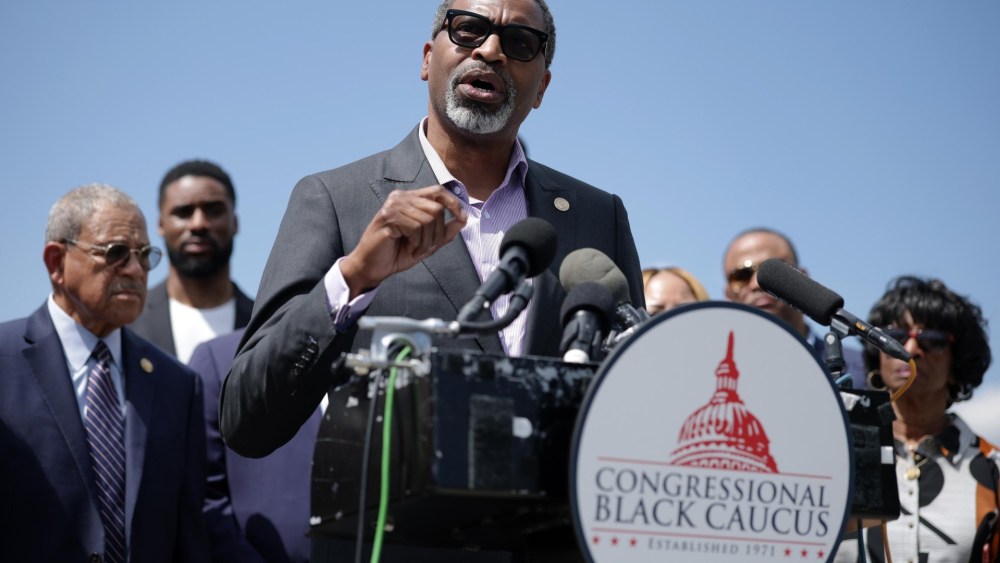
First, the Congressional Black Caucus announced its unanimous opposition to the SCORE Act, a major reform to college athletics backed by university and conference leaders for the NCAA, the SEC and the ACC.
In a statement, members argued they could not support athletic institutions that “remain silent” in the face of Republican moves to eliminate majority-Black congressional districts. According to recent reports, the NCAA, SEC and ACC do not appear to have publicly responded to the redistricting controversy, a silence that has become central to criticism from the Congressional Black Caucus and NAACP.
Then, the NAACP launched its “Out of Bounds” campaign, calling on Black athletes, potential recruits, families and fans to reconsider supporting universities in states aggressively moving to weaken Black political representation after the Supreme Court’s decision in Louisiana v. Callais.
Taken together, the moves signal something larger than frustration. They reflect a growing consensus among Black leaders that neutrality from powerful institutions is not acceptable when democracy itself is under attack.
Play
NAACP urges Black student athletes to boycott southern college sports programs over redistricting
May 20, 2026 / 04:42
Conservatives predictably attacked the moves, casting student athletes as pawns in a political game, arguing that athletes would rather get a paycheck than stand in solidarity or just mocking the idea of playing somewhere other than a big southern college.
But young people have always been central to movements for democratic change in this country.
During the civil rights movement, students
by Anthony L. Fisher | May 23, 2026 | Opinion
Watching Hunter Biden’s nearly two-hour interview with the antisemitic megastar podcaster Candace Owens was, as you might expect, not an intellectually rewarding experience. But that’s not to say it didn’t have some accidentally illuminating moments.
Despite Owens’ considerable talent for monetizing content that appeals to bigots and conspiracy theorists — a significant portion of the MAGA movement — she is not well-read, appears to have no principles that can’t be jettisoned at a moment’s notice and her body of work serves as further evidence backing up the scientifically documented link between racism and stupidity.
Hunter Biden, it’s hard to believe these days, was just a couple of years ago a very influential person by virtue of nothing more than being President Joe Biden’s son. He was a key voice in the Biden inner circle and infamously urged his father to continue his doomed re-election campaign even after his disastrous debate performance. That was absurdly inept counsel that proved to be a hugely important factor in returning Trump to office.
Hunter Biden’s comeback tour has him playing the self-pitying sad-sack, whining to Owens that people think he’s just some “ne’er do well who never did anything in their life.”
But that wasn’t the only way Hunter Biden was of great value to the Trump campaign. Although multiple investigations into his foreign business affairs found no evidence that the elder Biden did anything wrong, Trump and MAGA portrayed the Biden son’s alleged attempts at low-level influence-peddling as the ultimate examples in self-dealing and government corruption. People including Owens often said Hunter Biden was emblematic of the “Biden crime family.” (Owens also said in 2021 that Joe
by Zeeshan Aleem | May 23, 2026 | Opinion
Therapists across the country are seeing a surge in clients who say politics is taking a toll on their mental health, according to a new article in Politico Magazine. One therapist told the publication, “This is the first time that we’re really seeing people initiating therapy because of political [anxiety].”
An American Psychological Association survey found that about two-thirds of Americans said politics was a significant source of stress in their lives in 2025. Politico reports that psychological associations are holding workshops on addressing mental health problems tied to politics, and clinics are holding staff meetings on tackling the issue. Some therapists are even specializing in political anxiety. A friend who works as a therapist told me that he lists “climate grief” as an area of expertise.
I am not a therapist. But I have thought about and engaged with politics day in and day out for most of my life without going (entirely) crazy. When friends and acquaintances ask me, with increasing frequency, how to deal with the stress of paying close attention to a world awash in crisis, I share the following thoughts.
A healthy media diet is not unlike a healthy food diet.
As many political thinkers on the left have argued, optimism is not just a temperament. It is a strategy and outlook that can be consciously cultivated, especially in concert with others. Even when it may feel pointless, focusing on what can be done is worthwhile. Expressing dissent, minimizing harm, notching incremental wins and building networks and ideas for the future are not just the right things to do — they build discipline and faith in action that can
by Ebony Davis | May 23, 2026 | News
Commerce Secretary Howard Lutnick donated $5 million to House Republicans shortly before appearing for closed-door testimony before the House Oversight Committee investigating ties to the late convicted sex offender Jeffrey Epstein, according to a recent Federal Election Commission filing.
The contribution was made to the Congressional Leadership Fund, the main super PAC aligned with House Republican leadership that helps fund competitive congressional races. The hefty donation was made on April 1, four weeks before Lutnick sat for a transcribed interview with lawmakers examining his relationship with Epstein and discrepancies in his previous public statements about the extent of their association.
“Mr. Lutnick made a political donation in his personal capacity, just as many Cabinet Secretaries from both parties have done in the past,” Kristen Eichamer, a spokeswoman for the Department of Commerce, said in a statement to MS NOW.
The House Oversight Committee did not immediately respond to MS NOW’s request for comment.
Lutnick has long been one of President Donald Trump’s top financial supporters and fundraisers. During the 2024 election cycle, he contributed millions of dollars to Trump’s re-election campaign, hosted high-dollar fundraising events and later joined Trump’s transition team before being selected to serve as commerce secretary in the president’s second administration.
Despite being a major Republican donor, the latest donation marked his first political contribution since assuming the role.
Lutnick, the former CEO of Cantor Fitzgerald, testified before the bipartisan committee on May 6 in a transcribed interview focused on his relationship with Epstein and questions surrounding previously undisclosed interactions between the two men.
Lawmakers have been reviewing newly released Epstein files and testimony from former associates as part of a broader inquiry into how Epstein maintained ties to powerful figures
by Ebony Davis | May 23, 2026 | News
The U.S. Citizenship and Immigration Services announced Friday that it will sharply limit when immigrants already inside the United States can apply for permanent residency.
In a new policy memo, the agency said most noncitizens seeking a green card must instead leave the U.S. and complete the process through consular offices overseen by the U.S. Department of State in their home countries.
USCIS spokesperson Zach Kahler said in a statement that the rule applies to noncitizens who are temporarily in the U.S., except for those “in extraordinary circumstances,” noting that the U.S. was “returning to the original intent of the law.”
“This policy allows our immigration system to function as the law intended instead of incentivizing loopholes,” Kahler said. “When aliens apply from their home country, it reduces the need to find and remove those who decide to slip into the shadows and remain in the U.S. illegally after being denied residency.”
In a second statement to MS NOW on Friday evening, Kahler suggested applicants who provide economic gain will likely still be allowed to apply from within the U.S.
“While we work to operationalize this, people who present applications that provide an economic benefit or otherwise are in the national interest will likely be able to continue on their current path while others may be asked to apply abroad depending on individualized circumstances,” he said.
The move marks a significant tightening of immigration policy under the Trump administration and could affect thousands of people living in the U.S. on nonimmigrant visas, including international students, temporary workers and tourists.
Prior to the new policy, people living legally in the U.S. on nonimmigrant visas could later become eligible for green