by Hayes Brown | May 26, 2026 | Opinion
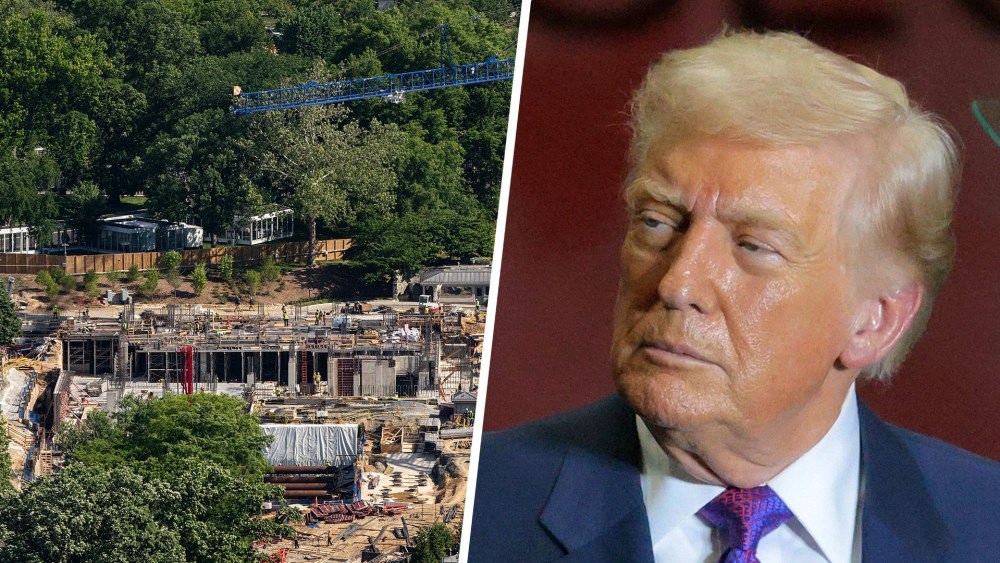
There are few things President Donald Trump hates to hear more than “no.” So imagine his outrage when he learned that Senate Republicans’ long-awaited budget bill would no longer include money for his White House ballroom project. The $1 billion in Secret Service funding, including $200 million specifically for the ballroom, had to be removed after a ruling that it failed to comply with Senate rules.
The ruling on the funding didn’t come from Senate Majority Leader John Thune, R-S.D., or any other elected member of Congress. It came from Elizabeth MacDonough, the Senate parliamentarian. Trump has demanded that Thune fire MacDonough for standing in his way — but her job isn’t at risk. For the moment, at least, MacDonough may be the most powerful bureaucrat in Washington that Trump can’t touch.
For the moment, at least, MacDonough may be the most powerful bureaucrat in Washington that Trump can’t touch.
After weeks of internal debate, Senate Republicans decided to keep the budget reconciliation bill narrowly focused on funding for Immigration and Customs Enforcement and Border Patrol. The money would backfill a gap left in this year’s Department of Homeland Security appropriations bill to appease Democrats opposed to Trump’s anti-immigrant crackdown.
Reconciliation bills have the benefit of not being subject to the filibuster or the associated 60-vote threshold. But because of how much reconciliation bills short-circuit the normal legislative process, the Senate has written guidelines into the budget law governing them. In short, anything packed inside must deal with federal spending, adjusting the amount of money the government takes in as revenue or spends as outlays. There are also provisions ensuring that spending bills match
by The Associated Press | May 26, 2026 | News
WASHINGTON (AP) — The U.S. military said Monday that it carried out “self-defense” strikes in southern Iran, including on missile launch sites and boats placing mines, even as President Donald Trump said on social media that negotiations were “proceeding nicely.”
The strikes were done “to protect our troops from threats posed by Iranian forces,” but the military was “using restraint during the ongoing ceasefire,” Capt. Tim Hawkins, U.S. Central Command spokesman, said in a statement.
Further details were not immediately available, including more specifics on the threats from Iran and what this means for negotiations. Earlier, Trump said any agreement to end the Iran war should include a requirement for several additional countries, including Saudi Arabia and Pakistan, to join the Abraham Accords, the U.S.-brokered agreements from Trump’s first term aimed at normalizing relations with Israel.
The proposal came as the emerging Iran deal faced criticism from fellow Republicans who favor a harder line on Iran, and it could add new diplomatic complications to the negotiations.
Trump pointed to Saudi Arabia and Qatar as countries that should “immediately” sign on, alongside Pakistan, Turkey, Egypt and Jordan. Bahrain and the United Arab Emirates became the first countries to join in 2020.
He wrote that “after all the work done by the United States to try and pull this very complex puzzle together, it should be mandatory that all of these Countries, at a minimum, simultaneously sign onto the Abraham Accords.”
Trump has long hoped Saudi Arabia would join, but the kingdom has maintained that any normalization deal requires first establishing a clear path for Palestinian statehood. That’s also key for Pakistan, which is among the countries that do not have diplomatic relations with Israel.
Islamabad-based
by Lt. Col. Rachel E. VanLandingham (ret.) | May 25, 2026 | Opinion, Politics
On this Memorial Day, we should take stock that the U.S. military remains one of the most respected public institutions in America. And for good reason. Our military has strived mightily since its Vietnam War nadir to foster professionalism grounded on honor and implemented programs to help ensure that the American way of fighting comports with the law of war and American values to the greatest extent possible.
The Pentagon should honor service members who have paid the ultimate sacrifice this Memorial Day by recommitting to the American way of fighting. It should pay tribute to the fallen by reinforcing moral integrity for those currently serving.
The U.S. military remains one of the most respected public institutions in America.
One tangible way our military and civilian leaders can do this is by firmly and quickly owning the mistakes that have killed or injured civilians in our war in Iran. Prompt and transparent investigations should lead to lessons in how to avoid future tragedies and assure those in uniform, the American public and our country’s allies that our military operations comport with U.S. values and the law.
This is not a hypothetical plea. A U.S. missile strike killed almost 200 Iranian girls and their teachers on the first day of the war, and there has been no formal U.S. acknowledgment, explanation or apology to date. There are also credible allegations, reportedly verified by The New York Times, that the U.S. has struck 22 civilian schools and medical facilities in Iran.
President Donald Trump’s Pentagon has systematically dismantled the “Civilian Harm Mitigation and Response” program, a comprehensive effort to mitigate civilian deaths and injuries caused by U.S. military operations.
by Robin Andersen | May 25, 2026 | Corporate Media, Excerpt, Gaza, Genocide, Israel, Palestine, Propaganda
News stories vie for our attention, our agreement, our understanding, and our view of what is real, and possibly most importantly, what is just. Journalists, reporters, and editors at the major US news outlets narrated the war for us, they imposed meaning, included evaluation, interpretations, and judgment. They also hid much of the truth of the violence. Interpretations and judgments arrive…
Source
by Susan Del Percio | May 25, 2026 | Congress, Opinion
Lawmakers left Washington for the holiday weekend on Friday, fleeing the chaos that once again threatened to engulf Capitol Hill. As the architect of much of that chaos, the president’s motivations seem relatively clear. But what about the Republican lawmakers who, for once, appeared ready to stand up to him?
It was just last month, during the talks to end the Department of Homeland Security shutdown, that President Donald Trump demanded congressional Republicans agree to fund Immigration and Customs Enforcement and Border Patrol through the special budget reconciliation process “no later” than June 1.
And indeed, the $72 billion funding bill appeared on the verge of being passed by the Senate, until Trump swooped in at the last minute and derailed it with the creation of his $1.776 “anti-weaponization” fund.
Senate Republicans typically offer more muted criticism, but this fund’s legal and ethical problems — or at least, the perception of those problems — was too much for some lawmakers to stomach.
Senate Republicans typically offer more muted criticism, but this fund’s legal and ethical problems — or at least, the perception of those problems — was too much for some lawmakers to stomach. And they subsequently unloaded on acting Attorney General Todd Blanche in an unusually frank closed-door meeting. According to Punchbowl News, “GOP senators — around 25 of them, an exceptionally high number for these closed-door meetings — took turns blasting the proposal and lamenting that they were being put in this situation.”
As a result, the vote was called off, Trump will not get his ICE and Border Patrol funding approved by the June deadline, and Republicans will have to go home to face their