by Victoria Law | Jun 27, 2026 | California, Federal Bureau of Prisons, LGBTQ, New Jersey, New York, News, Sexual Harassment, trans prisoners, Trans Rights
“I am the ONLY female being held in a male prison here in New Jersey all because I am transgender,” Gia Valentina told Truthout. In January 2026, after years of requesting the procedure, Valentina had vaginoplasty, a gender-affirming surgery that creates a vagina and vulva. She was hoping that the procedure would allow her to be moved to Edna Mahan Correctional Facility, New Jersey’s sole…
Source

by Paul Waldman | Jun 27, 2026 | Opinion, White House
For half a century, Watergate has been the quintessential American scandal, so much so that we frequently affix “-gate” to new episodes of official wrongdoing in an attempt to make it sound significant and sinister.
But what if, asked Vice President JD Vance, we consider Watergate no big deal? Or even better, why not decide that former President Richard Nixon, our pre-Trump model of corruption and abuse of office, was not the perpetrator of Watergate but its victim?
“I’m actually fascinated by Nixon as a character in history,” Vance said at an appearance this week at the Nixon Library in California. “I think that his historical legacy is enjoying a bit of a renaissance, but I think deservedly so. As I joked with Robert backstage, if Watergate happened tomorrow, it would be like a 12-hour news story. Like, the idea that it would have taken down a presidency is crazy.”
Rewriting history is a longtime hobby of American conservatives.
Vance continued: “And by the way, if you look at the story of how the deep state took down Richard Nixon, it’s not all that different from what the same groups of people, the same institutions tried to do to Donald Trump and the first Trump administration. There is a parallel.”
Rewriting history is a longtime hobby of American conservatives, both to absolve them of their sins and reshape the American mind to align with their values. For instance, the “Lost Cause” counternarrative of the Civil War, which portrays the Confederacy’s treasonous slavery advocates into noble men simply defending their homes, continues to this day, with the Trump administration renaming military bases and erecting statues to
by Symone D. Sanders Townsend | Jun 27, 2026 | Opinion
President Donald Trump can be unpredictable. He changes his mind based on who last talked with him. He has no real interest in the day-to-day work of running the federal government.
But beneath the chaos, he does have a governing philosophy.
The ongoing debacle of the Reflecting Pool has been a helpful distillation of his approach: Make a big promise, use it to reward your allies, blame setbacks on your opponents, criminalize dissent and then attack the press.
The first three steps are fairly common in politics, especially among populists with little experience in government. But it’s the last two that turn Trump into something more than just a run-of-the-mill incompetent politician.
Authoritarianism often begins with the habit of treating ordinary problems as criminal conspiracies. A court strikes down his policy, and he calls the judge “crooked” or “corrupt.” A protest escalates, and he calls the protesters “paid agitators.”
If an authoritarian government cannot accept criticism, then it has to label critics enemies. If it cannot admit a mistake, then it has to blame sabotage. And if it cannot accept failure, then it has to find someone to punish.
The fact that Trump used these tactics on the Reflecting Pool may be comical, but it’s also ominous.
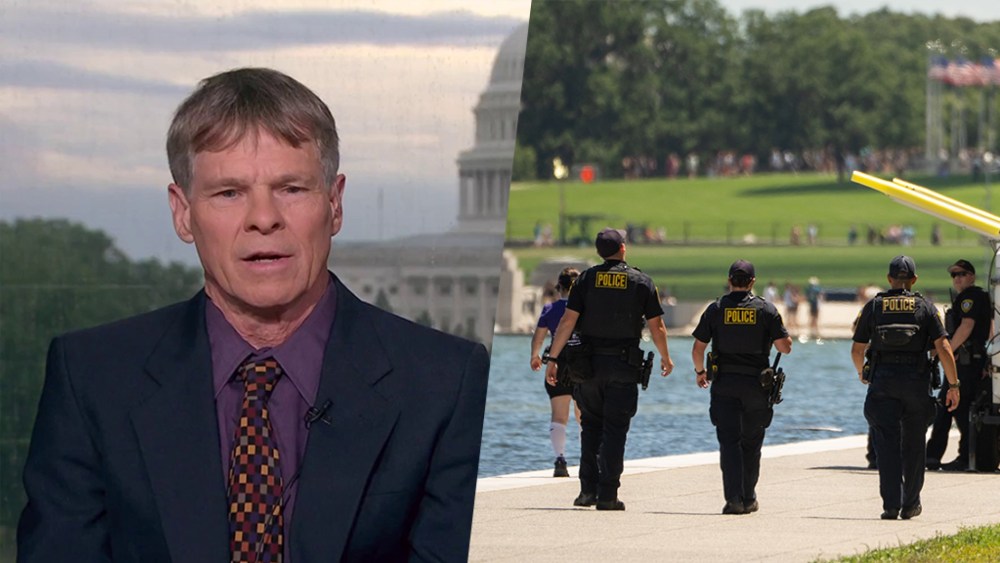
Earlier this week, federal officers arrested multiple people at the Lincoln Memorial Reflecting Pool after Trump blamed “vandals” for damage to the newly renovated monument.
So far, the only one we know is facing charges is a former Olympian who says he simply stopped during a bike ride, reached down and touched a piece of blue coating that had already peeled away from the bottom of the pool.
Play
Olympian arrested after
by Julia Jester | Jun 27, 2026 | News
Israel, Lebanon and the United States signed a framework toward peace on Friday, capping four marathon days of talks in Washington and pulling the fate of the conflict in Lebanon away from the Iranian regime.
“For Lebanon, this Framework provides a genuine pathway out of a long crisis. For Israel, it creates a verifiable path to removing the persistent threat on its northern border,” Secretary of State Marco Rubio said in a statement after announcing the U.S.-mediated agreement.
According to a copy of the 14-point framework obtained by MS NOW, Israel and Lebanon declared their intent to “conclusively end the conflict” and committed to a “reciprocal, sequenced process, with clear conditions” for the Israeli army to progressively withdraw from Lebanon pending the verified disarmament of Iran-backed Hezbollah militants by the Lebanese Armed Forces.
Among other resources, the U.S. is committing $100 million toward the peace effort in humanitarian assistance through the United Nations and $30 million for the LAF under existing Pentagon appropriations, the State Department said.
The fifth round of political and military discussions went into an unexpected fourth day after needing more time to hammer out the fine details regarding the implementation of pilot security zones, two sources familiar with the peace talks, granted anonymity to discuss sensitive diplomatic negotiations, told MS NOW.
The framework maintains Israel’s presence in southern Lebanon while establishing two initial pilot zones, mutually agreed upon by Israel’s and Lebanon’s militaries, allowing Lebanese forces to gradually assume full security responsibility after disarming and dismantling Hezbollah. It also calls for international support, particularly from Arab partners, in helping the Lebanese government to exercise full sovereignty over its territory and
by The Associated Press | Jun 27, 2026 | News
WASHINGTON (AP) — The U.S. struck Iran on Friday in response to a drone attack a day earlier on a cargo ship in the Strait of Hormuz. It’s the most significant test yet to an interim understanding reached a week ago by the two countries to begin working to end their months-long war and reopen the pivotal waterway.
U.S. President Donald Trump said the drone attack violated the ceasefire. The strikes came shortly after Trump told reporters, “You’ll find out,” whether the U.S. would respond.
U.S. Central Command said the military struck missile and drone locations and coastal radar sites in Iran.
“I don’t like the fact that they took a shot yesterday, actually four of them,” Trump said at the White House shortly before the U.S. struck back. When asked why there would be strikes when Trump has insisted talks with Tehran are going well, Trump said of Iran: “They’re a little bit different.”
He then abruptly cut off questions and reporters were ushered out of his office.
Ebrahim Azizi, who heads the Iranian parliament’s national security commission, responded to Trump on social media earlier Friday, saying, “the Strait of Hormuz is governed by Iran, so: Respect the rules” and to “not mistake control for escalation.”
“This is not a violation of the ceasefire; it is ceasefire management,” Azizi wrote.
Friday evening, Vice President JD Vance said on social media that Iran should “pick up the phone” if there are disagreements about the ceasefire agreement.
“But violence will be met with violence,” Vance said.
Strikes conclude an hour later
The U.S. strikes on Iran concluded about an hour after U.S. Central Command announced the military action on social media, a U.S. official with knowledge of